On this page
A 20-minute video needs about 2,800 words at 140 words a minute. Collect a dozen sourced facts, open on a real moment with a date and a place, split the rest into 3 to 5 chapters that each answer one question, write for the ear, and edit every draft yourself. Your own research and edits are what keep a video from looking mass-produced.
How long should the script be?
Multiply the minutes by 140, which is a typical pace for narration. An AI voice or a live reader can be a little faster or slower.
| Video length | Words | Facts to collect | Chapters |
|---|---|---|---|
| 8 min | 1,120 | 6–8 | 2–3 |
| 15 min | 2,100 | 10–12 | 3–4 |
| 20 min | 2,800 | 12–15 | 3–5 |
| 30 min | 4,200 | 18–25 | 5–7 |
Should you go longer? In our data, length alone didn't make much difference. Young channels averaging 8 to 25 minutes grew about the same, around 4% in 28 days. Those at 25 to 40 minutes grew a bit faster, 5.8%, but that doesn't show longer videos caused it. Make it as long as your story holds up. If you're padding at minute 15, it's a 14-minute video.
Start with facts
Write nothing until you have your facts. Each one needs a source you've actually opened. Here's what a fact sheet looks like, using a real story. An encyclopedia is a place to start. Follow its references to the original source when you can:
| Fact | Source | Note |
|---|---|---|
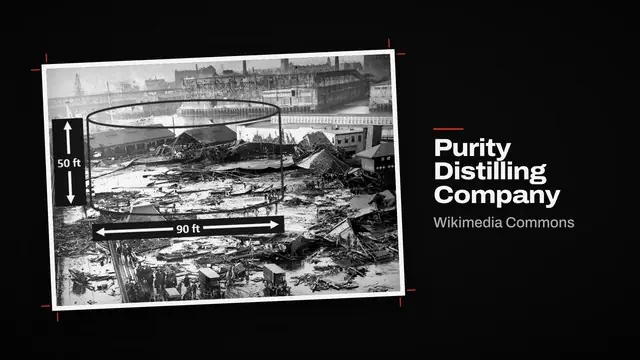
| January 15, 1919, about 12:30 pm: a molasses tank burst in Boston's North End | Wikipedia, then the sources it cites | |
| 2.3 million gallons | Same | |
| A wave up to 25 feet high, about 35 miles an hour | Same | Estimates: say "up to" and "about" |
| 21 people died, about 150 were injured | Same | |
| The company blamed anarchists | Same | Say who claimed it |
An encyclopedia won't cover everything, especially small towns or little-known companies. Places worth checking:
| Looking for | Try |
|---|---|
| Population, income, housing | US Census data |
| What happened at the time | Chronicling America, local newspaper archives |
| Old books, reports, magazines | Internet Archive |
| Places and maps | USGS historical maps, county and city websites |
| Companies | Annual reports, court records, trade magazines |
Three rules that save you later:
- A number needs a source, or it goes. If you can't find where it came from, cut the line, however good it sounds.
- Say "about" when the source does. Estimates become false the moment you state them as exact.
- Be careful with real people. Check names, and don't state accusations as facts. If a story is about living people or victims, it takes extra care.
I'm writing a [length]-minute YouTube documentary about [topic].
List 15 specific facts: dates, numbers, names, places. For each, give the source and link.
Mark anything you're not sure of as UNVERIFIED. Don't guess at numbers.
I'll check each one myself.
AI models can invent sources that look real. Open every link. If the page doesn't say what the model claims, you don't have that fact yet.
Get all 5 lessons and the templates by email
One short email a day. The lessons stay open here either way.
How do you open?
Open on a real moment. Then show the scale, the pattern, and what the viewer will get. You've got about 50 to 100 seconds to do this properly.
| Part | What it does | Example |
|---|---|---|
| A real moment | Date, place, something happening | At half past noon on January 15, 1919, a steel tank in Boston's North End split open. |
| Scale | How big | 2.3 million gallons of molasses rolled into the street, in a wave up to 25 feet high. 21 people died. |
| Pattern | Why it matters beyond this one moment | The company blamed anarchists. The tank may have leaked from the day it was filled. |
| Promise | What you'll know by the end | This is how a disaster that sounds almost funny changed the way America builds things. |
And what not to do:
| Weak opening | Why it fails |
|---|---|
| "Hello and welcome back to the channel. Today we're talking about..." | Nothing has happened yet |
| "Throughout history, many disasters have changed the world." | Could open any video |
| "The early 20th century was a time of industrial growth." | Background, before anyone cares |
End your video by going back to that opening moment. It gives the story a shape, and people can tell when a video actually finishes.
How do you structure chapters?
Each chapter answers one question and ends on the next one. That's the reason to keep watching.
| Chapter | Question it answers | It ends on |
|---|---|---|
| 1. A tank built to fail | Why was a huge tank in a crowded neighbourhood? | Then, one January day, it gave way |
| 2. The wave | What actually happened in those minutes? | Who was going to pay for this? |
| 3. The trial | Whose fault was it? | What changed because of the verdict? |
| 4. What engineers still check | What does it mean today? | Back to the street, now |
For a countdown, each item is a block: where it is, one thing you won't find elsewhere, the facts, the catch, a bridge to the next. Be honest about the catch. It's what viewers trust you for, and it's often more interesting than the good part.
How do you turn the outline into a full script?
Now write the whole thing. Writing every word yourself can take a few hours. An AI draft from your checked facts takes minutes, and then the time goes into reading and fixing it. Once you know your niche, that gets quick.
Write a [length]-minute YouTube narration, about [number] words, using only the facts below.

Title: [title]
What the viewer will know by the end: [one sentence]
Chapters: [your outline]
Facts and sources: [your fact sheet]

Rules:
- Spoken English, in short sentences. No headings or stage directions.
- Open on the real moment in my outline, and return to it at the end.
- End each chapter on the question the next one answers.
- Don't add any fact that isn't in my list. Where one is missing, write [NEED SOURCE].
- No filler like "little did they know" or "but that wasn't all".
Then edit it three times:
- Facts. Check every number and name against your sheet. Deal with each [NEED SOURCE].
- Boring parts. Delete any sentence that could appear in any video. Add something of your own: a comparison, an opinion you can back up.
- Sound. Read it aloud, and fix anywhere you stumble.
Want it faster? In lesson 4, ViCut's Idea mode researches and drafts a script from your topic in about 10 minutes, which you then edit. That part is paid.
How do you write for the ear?
People hear your script once. They can't reread a sentence.
| Written for the eye | Written for the ear |
|---|---|
| The town, which was incorporated in 1887 and experienced significant population decline following the closure of its primary employer, today has 1,204 residents. | The town's mill closed. Most people left. About 1,200 are still here. |
| 37.4 percent | More than a third |
| Numerous residents expressed dissatisfaction. | People were furious. |
And every sentence needs something to show. That's the rule of faceless video: a place, a person, an object, a document or a map.
| Hard to show | Easy to show |
|---|---|
| The economy of the region declined. | Main Street, 1970: every storefront open. The same street, today. |
| Many felt it was a turning point. | The newspaper's front page, the next morning. |
Read the whole thing aloud once. Wherever you stumble or run out of breath, the voice will too. Check how place names are pronounced as well. Viewers notice when a narrator gets their town wrong.
How do you use AI without making a generic video?
AI is fine as a tool. YouTube's policy targets content that's mass-produced, generic and repetitive. The danger is publishing what comes out unchanged, because that's what sounds the same as everyone else's.
Keep these parts for yourself:
- Choose the story and the angle. That's your judgment.
- Check every fact.
- Cut the filler. Anything like "little did they know" or "but that wasn't all", and any sentence that could appear in any video.
- Add one thing nobody else has: a comparison, a document you found, an opinion you can back up.
Here is my script: [paste]. Act as an impatient viewer.
1. Where would you stop watching, and why?
2. Which sentences can't be shown on screen?
3. Which claims have no number, name or source?
4. Does the first 60 seconds keep the promise of the title: [title]?
Quote the lines. Don't rewrite the script.
Here are the titles and openings of my last videos: [paste].
Would a reviewer see these as different videos, or one template with the names swapped?
Point to what repeats: structure, phrases, hooks. Suggest how to make the next one different.
A full script, edited by you.
Collect your facts, write the opening, outline the chapters, then draft and edit. Use the documentary or countdown template from your extras. Can't finish it yet? Lesson 4's Idea mode can draft from your outline.
Questions about this lesson
How many words is a 20-minute YouTube script?
About 2,800 at 140 words a minute.
Can I use ChatGPT or Claude to write my script?
Yes, for research and drafts. Check every fact, and edit it heavily. Publishing drafts unchanged is how you end up with a channel that looks mass-produced.
How long should a YouTube intro be?
As long as it takes to give a real moment, the scale, and what the viewer will get: about 50 to 100 seconds for a long video.
Sources and further reading
- 1
- 2How young YouTube channels grow · ViCut
Make your first video
One rendered video. 11 min.